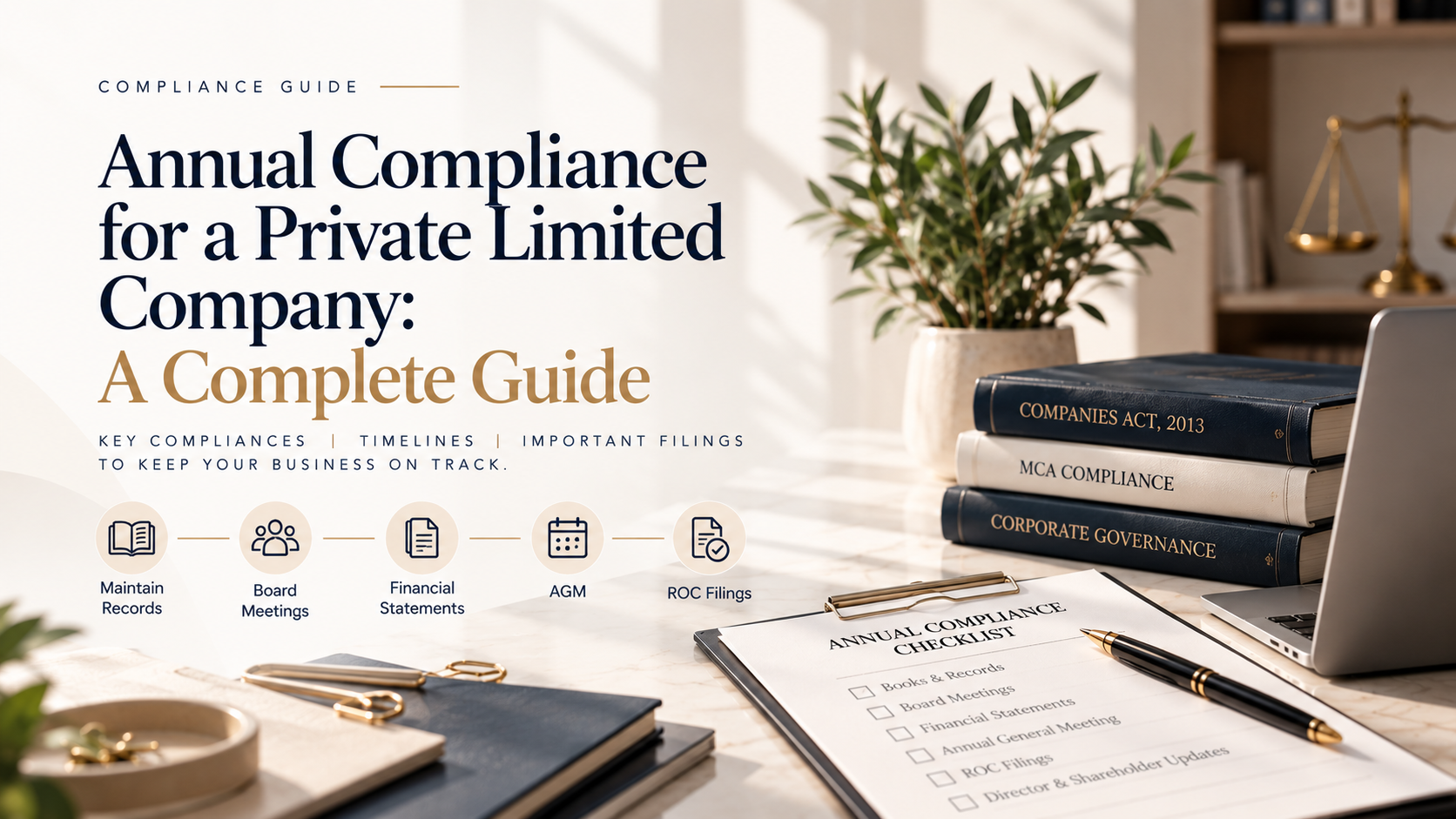
Incorporating a Private Limited Company is only the first step. Once the company is registered, it has ongoing legal, financial and secretarial responsibilities that need to be tracked throughout the year.
Annual compliance is not simply about filing forms at the end of the financial year. It involves maintaining proper records, completing required meetings, preparing financial statements and submitting applicable information to the Registrar of Companies (ROC).
Here is a simple overview of the key areas every private company should keep track of.
1. Maintain Proper Books and Records
A company should maintain accurate financial and corporate records throughout the year.
This can include:
Books of accounts
Financial records
Statutory registers
Shareholder records
Director records
Board meeting documents
Important agreements and contracts
Resolutions and other corporate documents
Keeping these records updated throughout the year makes annual compliance much easier.
2. Hold the Required Board Meetings
Companies are required to conduct board meetings as applicable under the Companies Act, 2013.
Board meetings provide a formal mechanism for directors to review the company's affairs and take important decisions.
Proper notice, agenda, attendance and minutes should be maintained as applicable.
3. Prepare the Financial Statements
At the end of the financial year, the company's financial statements need to be prepared and approved in accordance with the applicable requirements.
These financial statements form an important part of the company's annual compliance process and may be required for filing with the ROC.
4. Conduct the Annual General Meeting
An applicable company is required to conduct its Annual General Meeting (AGM) within the prescribed timeline.
The AGM provides shareholders an opportunity to consider matters such as:
Financial statements
Directors' report
Auditors' report
Appointment or related matters concerning auditors, where applicable
Other matters requiring shareholder approval
The applicable requirements depend on the company's circumstances.
5. File Financial Statements with the ROC
Companies are generally required to file their financial statements and related documents with the Registrar of Companies through the applicable MCA forms.
Form AOC-4 is used for filing financial statements and other applicable documents with the Registrar. Certain companies may be subject to different forms or XBRL requirements.
6. File the Annual Return
The annual return contains important information about the company's corporate structure and affairs.
Depending on the company's classification, the applicable annual return form may differ. For example, MGT-7 is an annual return form, while MGT-7A is the abridged annual return form applicable to OPCs and small companies subject to the relevant conditions.
7. Keep Director and Company Information Updated
Changes during the year should not be ignored until the annual filing period.
Changes relating to directors, registered office, shareholding, capital structure and other corporate matters may trigger separate compliance requirements.
This is why companies should maintain a compliance tracker throughout the year rather than preparing everything at the last minute.
8. Don't Ignore Event-Based Compliance
Annual compliance is only one part of corporate compliance.
Certain business events can create additional filing or approval requirements.
For example:
Appointment or resignation of a director
Change in registered office
Issue or allotment of shares
Increase in authorised share capital
Change in the company's structure
Related-party transactions
Foreign investment
Changes in shareholding
Corporate restructuring
The applicable requirements depend on the specific transaction and circumstances.
A Simple Annual Compliance Checklist
Before closing the compliance cycle, ask:
☐ Are the company's books and records updated?
☐ Are statutory registers maintained?
☐ Have applicable board meetings been completed?
☐ Have financial statements been prepared and approved?
☐ Has the applicable AGM been conducted?
☐ Have applicable financial statements been filed with the ROC?
☐ Has the applicable annual return been filed?
☐ Have all event-based compliances during the year been completed?
☐ Are the company's director and shareholder records up to date?
Compliance Should Be a Year-Round Process
One of the biggest mistakes businesses make is treating compliance as a once-a-year activity.
A better approach is to maintain a compliance calendar and review the company's obligations throughout the year.
This helps businesses identify upcoming requirements early, maintain proper documentation and reduce the risk of last-minute filings.
The Ministry of Corporate Affairs continues to update its MCA V3 filing system and publish filing guidance and FAQs, so companies should always verify the applicable forms and current requirements before filing.
Final Thought
Good compliance is not just about submitting forms on time.
It is about keeping the company organised, properly documented and prepared for its next stage of growth.
At Nisha Tiwari & Associates, we help businesses navigate corporate compliance, governance and regulatory requirements with a practical, business-focused approach.


Comments
No comments yet. Be the first to share a note on this article.
Leave a comment